
BY: Karry King
November 9, 2023
LA SALLE, Illinois – Dan Murphy likes to take his dog fishing at the Little Vermillion River near his home in La Salle, Illinois, a rural community located ninety miles southwest of Chicago.
Murphy, 44, has been fishing and four-wheeling along the banks of the Little Vermillion River his entire life. He says that when he takes Baby Blue, his nine-year-old pit bull, she often gets a bacterial infection when she goes in the water.
“She doesn’t understand what danger she’s in,” Murphy said.
Murphy says the infection has happened at least a dozen times. His vet usually prescribes antibiotics, and it goes away. He rinses her with Bactine when they get home to prevent an infection.
Murphy lives near Carus Chemical, a company that manufactures chemicals used to treat drinking water. Potassium permanganate, the company’s main product, is used by municipalities in the U.S. and all over the world for water treatment. The chemical is also used in mining, fracking, refining crude oil, explosives and manufacturing cocaine. Since January, residents have learned there are heavy metals in their soil, water and air filters. They believe it is from the chemical factory and say the factory is not being properly regulated.
Murphy says Carus Chemical has a discharge pipe that empties wastewater from its factory into the river and says the river water smells like bacteria and chemicals in some areas. He recently took a sample of the mineral scale off the pipe that had built up over the years from the wastewater. When the test results came back, it showed that barium, cadmium, chromium, copper, lead, manganese, zinc and mercury were present in the scale.
Many LaSalle residents are concerned about Carus’ effect on the community after an explosion and massive fire at its factory near their homes in January 2023. During the fire, a chemical cloud formed above the town and rained green and purple chemicals onto the people and their properties. After the fire, many residents sent soil from their yards and furnace filters from inside their homes to a lab for testing and found the same metals that are in the scale.
Marty Schneider, 46, also grew up near the Carus plant, fishing, hiking and riding dirt bikes along the river. He bought a home ten years ago several blocks from Carus. He wasn’t worried about the plant.
“The neighborhood was up and coming,” Schneider said. “Carus has two signs outside about its safety record, promoting it. So, I never really paid any attention to it.”
He later learned that his home was part of a superfund site but was told by the U.S. EPA that Carus was not the source of the pollution. Carus’ sister company, M & H Zinc, no longer in business, was said to be the source of the metals in Schneider’s yard. The EPA replaced the soil in his and several other residents’ yards a few years ago. After the fire, heavy metals are back in Schneider’s yard.
Schneider is worried about his water now, too. He purchased a whole house filter after the fire and installed a reverse osmosis system at his kitchen sink for cooking and drinking water. He said that when he changed his whole house water filter this summer, it was black.
“I took my concerns down to the city and to the City Council meeting, and they brushed it off. So, I pulled out my whole house water filtration system filter and showed them how black it was,” Schneider said.
Schneider says that at the September meeting, he asked the city what was wrong with the water treatment, and the city said there was nothing wrong.
However, EPA Enforcement and Compliance History Online (ECHO) shows the City of La Salle’s water treatment plant has been in violation since July and has had multiple violations over the past three years.
The ECHO website shows pollutants found in the city wastewater include the same metals that were in the discharge pipe scale, soil and furnace filters from residents’ homes: barium, cadmium, chromium, copper, lead, manganese, mercury and zinc.
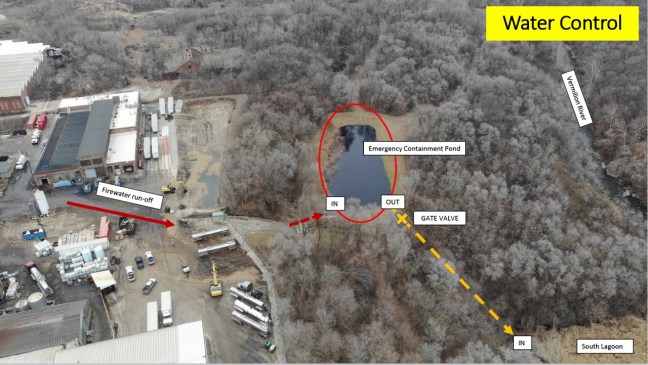
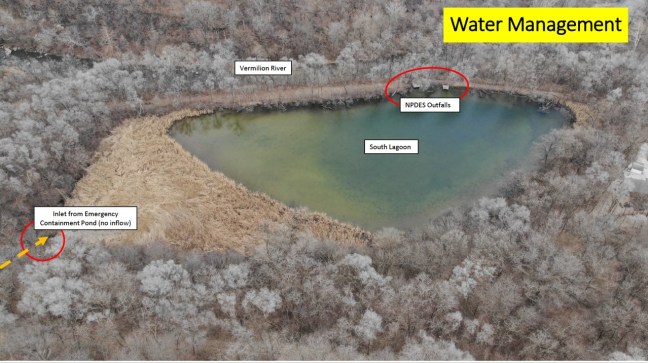
Carus has a permit to discharge 1 million gallons of chemical wastewater per day into the Little Vermillion River. Its National Pollution Discharge Elimination System (NPDES) permit, issued by the Illinois Environmental Protection Agency (IEPA), a state branch of the federal EPA, lists chloride and zinc as effluents allowed to be discharged by Carus.
There are no limits mentioned on the permit for the pollutants. It also does not list the other metals that were found in the scale.
Denise Trabbic Pointer, a chemical engineer and certified hazardous material manager emeritus, who has been volunteering to help La Salle residents with testing and analysis, says that metals and suspended solids found in the scale are leaching into the Little Vermillion River, but it’s difficult to know how much without regular testing.
“Carus is discharging with little oversight and an NPDES permit with few restrictions,” Trabbic-Pointer said. “The IEPA needs to pay more attention, perform more inspections and update the permit in 2024 to include more metals with actual criteria to reduce their impact to the river.”
She says the two lagoons where the chemical factory wastewater is held before discharge, and the river near the outfall and downstream, are not clear, and there appears to be a lot of algae growth.
“The Little Vermillion is already ‘impaired’ due to a total maximum load (TMDL) of chlorine pH, total suspended solids and zinc. Carus is listed in a 2018 TMDL review as a major contributor to zinc and chloride,” Trabbic-Pointer said.
Each metal in the scale has a slightly different effect on aquatic life. Mercury is particularly hazardous to the environment and to people.
“My opinion, just based on what I know, is that their discharge permits need to be amended to include more strict control on their discharge of zinc and other metals, chloride and suspended solids,” Trabbic-Pointer said. “Carus is rarely inspected.”
The company had two noncompliance items in 2020 and 2021 for air pollution violations but nothing for water in the IEPA document system.
Murphy and Schneider are both concerned about the effect these metals may have on their health. They want the EPA to regulate Carus better and for them to stop dumping chemicals into the river.
“It seems like they’re giving permits out and not following up,” Schneider said.
“It explains the amount of mental health problems and Alzheimer’s and diseases we have in this area, and the dementia rate, cancers and mental health issues,” Murphy said. “I’ll probably be crazy because I grew up down there.”
“I’m going to be demented from all the mercury soaking in through my clothes,” Murphy said.
 Protect Starved Rock and The Illinois Valley