From Clothing to Chemicals: Ottawa South Towne Mall is now a tier 2 chemical storage facility.

Chemical storage ordinance for Carus Chemical at Ottawa South Towne Mall

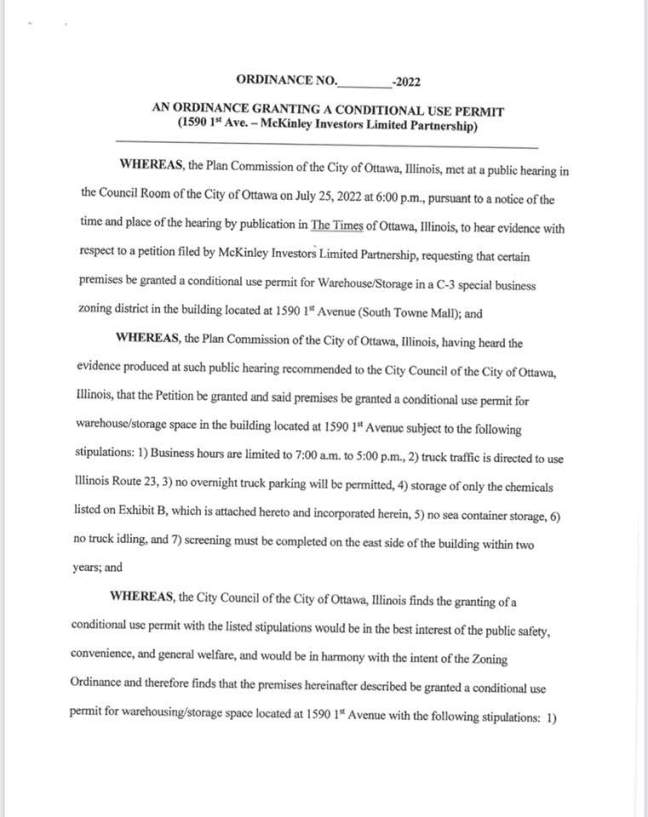
Ottawa’s city council met in July 2022 and approved Carus Chemical to use the Ottawa South Towne Mall to store hazardous chemicals.

Only one person went to the Ottawa City Council meeting when this proposal was being discussed.

According to Shaw Local News, the only reason he came was because he was concerned about the lawn getting mowed at the mall near his home.

Nobody came to ask questions about safety precautions, hazmat plans, or anything else about the proposal to store Carus’ chemicals at the Ottawa South Towne Mall.

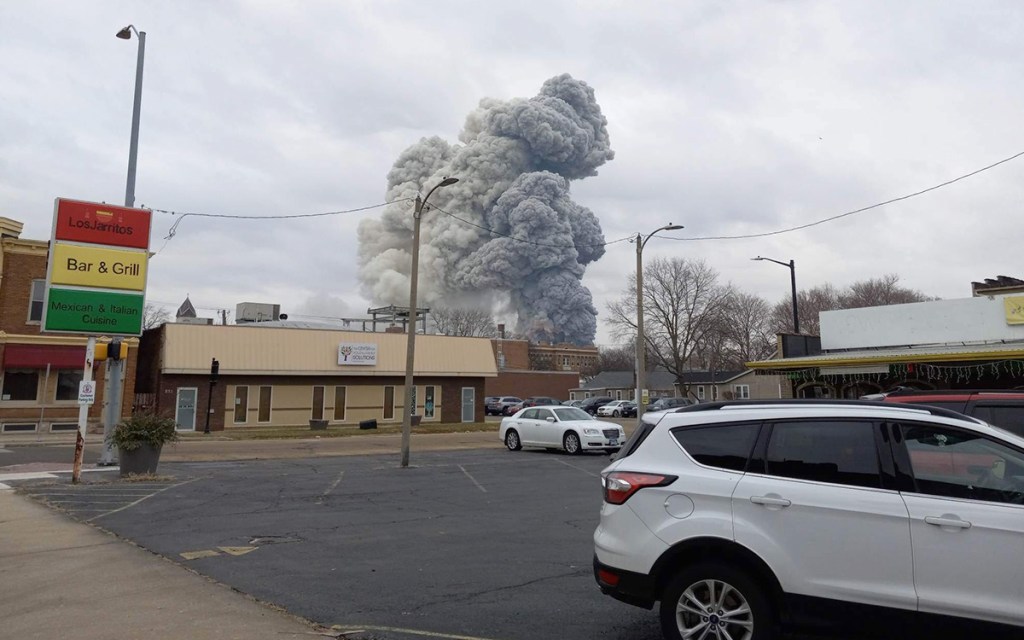
Fast forward to January 11, 2023 when an explosion occurred at Carus Chemical’s manufacturing plant in LaSalle, Illinois, that caused chemicals to rain down on the neighborhood and a massive fire to break out and release plumes of toxic smoke into the air.

The chemical, potassium permanganate, that blew up all over the LaSalle neighborhood is the same chemical that was approved for storage at the mall by Ottawa City Council, and is now being stored there.

Potassium permanganate is almost always presented by Shaw News, local politicians and Carus chemical as being for water treatment.

This makes it sound benign, like Carus is making these chemicals so we can have safe drinking water, as if they’re some kind of hero. 🐂💩

According to Carus’ website, potassium permanganate is used for treating fracking wastewater, separating metals in mining and in refining crude oil.

This is a hazardous, dangerous chemical that was approved for storage near a residential neighborhood and senior apartment complex in Ottawa, Illinois.

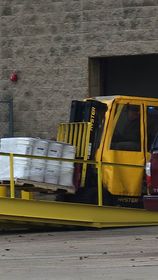
Last week, a neighbor next to Carus photographed and filmed semis hauling 7 loads of chemicals out of their warehouse in LaSalle, and followed them to the South Towne Mall, where they unloaded barrels and pallets for storage.

How will the City of Ottawa handle a situation like what happened in LaSalle when this same chemical started on fire and exploded?

As Jamie Hick’s said, “You’ve got our bomb now, Ottawa.” 💣

Ordinance for Ottawa Chemical Storage at South Towne Mall:

Shaw Local News: Request to use South Towne Mall in Ottawa as storage heads to City Council

By Michael Urbanec, Shaw Local News. July 25,2022

https://www.shawlocal.com/mywebtimes/2022/07/26/request-to-use-south-towne-mall-in-ottawa-as-storage-heads-to-city-council/?fbclid=IwAR0Yenr8Mz8o2rZggBs-iE6A95jSzmjltfHc0j8GrZnZbR_0E4E5iAKnNZo

Chemical Safety Data Sheets for Chemicals being stored at the former Ottawa South Towne Mall, Lotz Storage.

Chemicals being stored at this location include, but are not limited to the following:
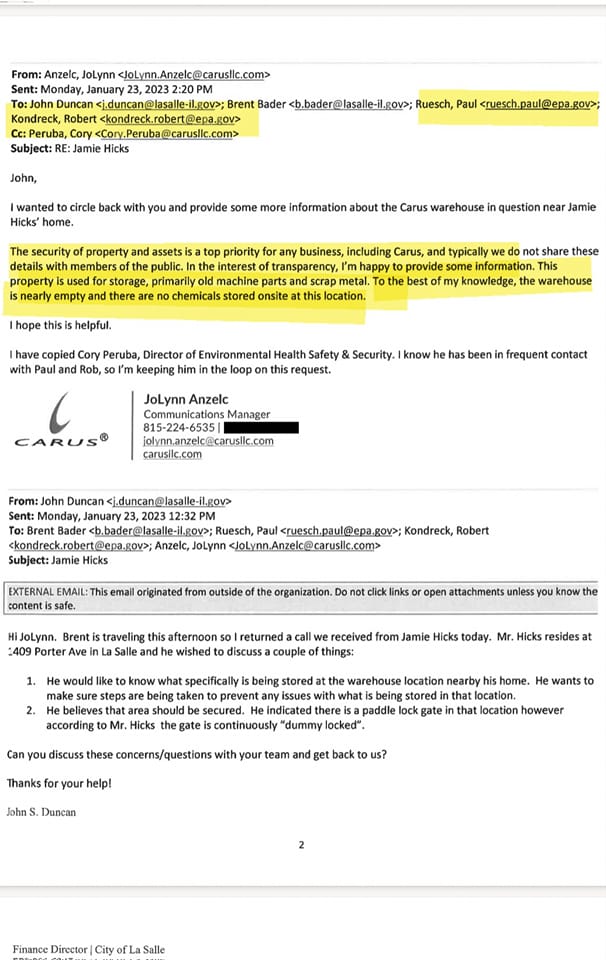
Carus Chemical Lied to the EPA about the Apollo Warehouse

Carus Chemical told the EPA they didn’t know what was inside the Apollo Warehouse, a building that is on their property, located next to a residential neighborhood, separated by a chain-link fence.

Meanwhile, 4 days after this email exchange between Carus Chemical and the EPA, Carus was photographed and filmed hauling 7 truckloads of unlabeled barrels and pallets out of the Apollo warehouse building, and transporting them to a tier 2 chemical storage facility, formerly known as the the Ottawa South Towne Mall, as can be seen in this video. https://www.facebook.com/jamie.hicks.547/videos/1802914950093166

Carus did not expect for neighbors to be so upset after their chemical plant blew up, and rained chemicals on the neighborhood, that the neighbors would learn how to use FOIA to gather evidence, then follow and photograph Carus’ every move.

Watching Carus scramble in attempt to hide these chemicals and move them out of the building where they are being illegally stored has been somewhat amusing.

Unfortunately, the City of LaSalle is helping Carus in their cover-up, as they provided a police escort for Carus’ semis to haul the illegally stored chemicals to a proper facility before the EPA came to inspect.

In addition, the semis did not have hazmat placards on them.

Emails obtained through FOIA have revealed that Carus contacted the chief of police and asked for off-the-clock officers to provide private security 24/7 for the next few weeks.

The chief responded by saying he will check with the officers and put together a schedule.

Who will these officers be loyal to in light of illegal activity – citizens or the polluter that is paying them?

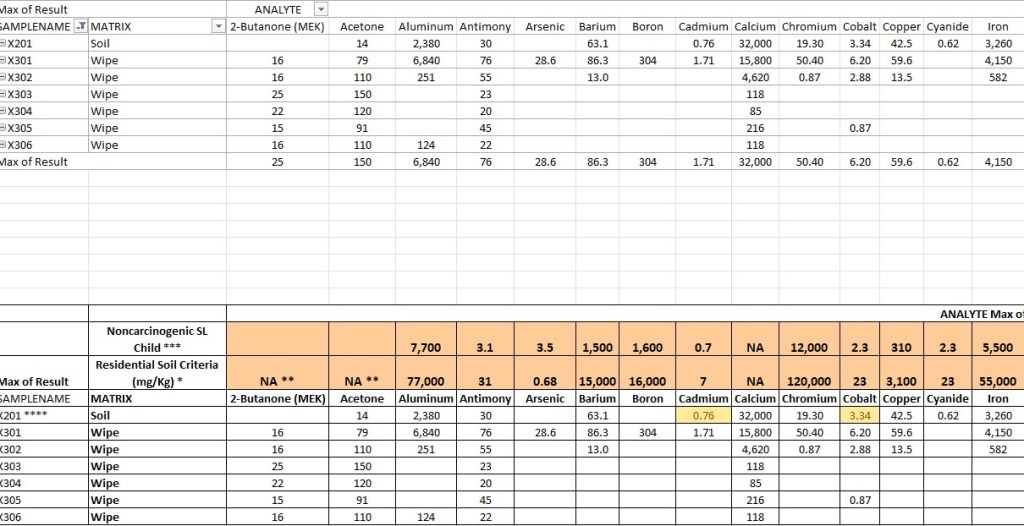
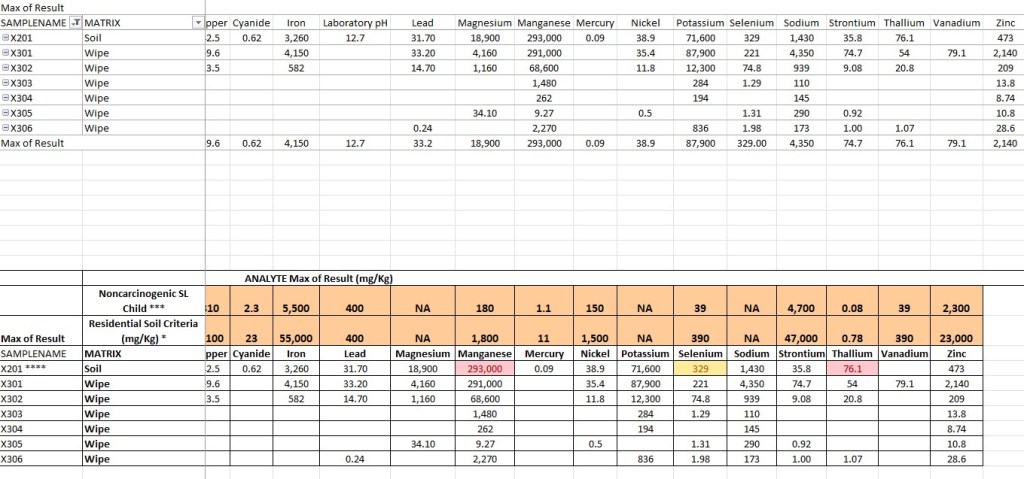
EPA Test Results & Sierra Club analysis of chemical samples taken 1/12/23 following the Carus Chemical explosion & fire

Sierra Club Analysis & Notes:

Sierra Club Analysis

The below information was provided by the Sierra Club:

Results compared to RSL in soil

The results for two metals, Manganese and Thallium were above the EPA regional screening levels (RSL) for residential soil. Three results, Selenium, Cadmium and Cobalt, were above the Noncarcinogenic Screening Levels – Child criteria.  The following are brief descriptions of the hazards of each of these metals. Keep in mind that the described health impacts are based on chronic exposures that are above the listed screening levels and do not describe the effect of a single acute exposure.

  • Manganese: Manganese in water poses minimal hazards, however, manganese is soil or dust does pose a significant hazard, especially through inhalation. Manganese toxicity can result in a permanent neurological disorder known as manganism with symptoms that include tremors, difficulty walking, and facial muscle spasms. These symptoms are often preceded by other lesser symptoms, including irritability, aggressiveness, and hallucinations. The average manganese soil concentrations in the United States is 40–900 mg/kg. Source: ATSDR – CDC. The maximum manganese level in this one soil sample was 293,000 mg/Kg. The screening level for a child that is listed is primarily based on ingestion of Manganese. The inhalation screening level for a child is 7,100 mg/Kg.
  • Thallium: Thallium blood concentration levels are normal below 2 µg/L, and toxic at concentrations greater than 200 µg/L. DELAYED EFFECTS OF EXPOSURE: Long-term effects of thallium exposure can include difficulty walking, various involuntary movement disorders, and impairment of thought and mood. Source: NIOSH – CDC High concentration of thallium in shallow soil also poses a notable threat due to possible uptake by plant roots and storage in plant biomass. As a result, thallium may enter the food chain and accumulate in living organisms, causing severe disorders and ultimately becoming fatal. Source: National Library of Medicine. The screening level for a child that is listed is primarily based on ingestion of Thallium.
  • Selenium: Selenium is a naturally occurring mineral required for good health. It is obtained from food, and the recommended dietary allowance is 55 μg/d for persons 14 years or older, with a tolerable upper intake limit of 400 μg/d. Selenium toxicity can occur with acute or chronic ingestion of excess selenium. Symptoms of selenium toxicity include nausea; vomiting; nail discoloration, brittleness, and loss; hair loss; fatigue; irritability; and foul breath odor (often described as “garlic breath”). Source: National Library of Medicine. The screening level for a child that is listed is primarily based on ingestion of Selenium.
  • Cadmium: Cadmium (Cd) is a post-transition metal that has been found to exhibit biological toxicity that is “teratogenic, carcinogenic, and mutagenic.” It is easily absorbed by crops, causes harm to crop growth and development, affects crop quality and yield, and, as part of the food chain, leads to damage to the lungs, liver, kidneys, bones, and reproductive organs, causes toxic effects to the immune and cardiovascular systems, and is associated with various diseases. The Agency for Toxic Substances and Disease Registry (ATSDR), lists Cd as the sixth most toxic substance that endangers human health. Source: National Library of Medicine. The screening level for a child that is listed is primarily based on ingestion of Cadmium.
  • Cobalt: Cobalt is a natural element found throughout the environment.  Acute (short-term) exposure to high levels of cobalt by inhalation in humans and animals results in respiratory effects, such as a significant decrease in ventilatory function, congestion, edema, and hemorrhage of the lung. Respiratory effects are also the major effects noted from chronic (long-term) exposure to cobalt by inhalation, with respiratory irritation, wheezing, asthma, pneumonia, and fibrosis noted.  Cardiac effects, congestion of the liver, kidneys, and conjunctiva, and immunological effects have also been noted in chronically-exposed humans.  Cobalt is an essential element in humans, as a constituent of vitamin B12.  Human studies are inconclusive regarding inhalation exposure to cobalt and cancer.  EPA has not classified cobalt for carcinogenicity. Source: US EPA. The screening level for a child that is listed is primarily based on ingestion of Cobalt.
  • Potassium: Note that there is no EPA RSL or SL for Potassium but the maximum level in the soil sample was 71,600 mg/Kg (ppm). Potassium is a major plant nutrient. Healthy levels of potassium in soil range from 40 to 80 ppm. There are no severe health impacts related to ingestion or exposure to potassium. However, your total intake of potassium should not be greater than the recommended amounts, unless ordered by your doctor. In some cases, too much potassium may cause muscle weakness, confusion, irregular heartbeat, or difficult breathing. Source: Mayo Clinic

I don’t know what criteria that Brownfield, the City or EPA will use as comparison of the results. That is why I used listed Generic Regional Screening Levels. Besides comparing each result to some criteria, Cumulative Impacts are something that needs to be considered by the responsible parties. Many of the symptoms of over-exposure to these metals are common and result in similar endpoints and so, in a cumulative or additive manner, can be more harmful in combination.

Sierra Club calls on EPA to take action after Carus Chemical explosion in LaSalle.

The Sierra Club has been a wonderful resource for the community as we navigate through the fallout of the Carus Chemical disaster.

As Hannah and Sonya wrote in the below article, what happened that day was straight out of a disaster movie – a chemical cloud covered the sky and rained down on the City of LaSalle, Illinois.

Residents who live closest to the chemical plant had the most fallout.

Emails obtained through FOIA revealed that Carus Chemical instructed the City how to handle the situation and when to inform residents as the events unfolded that day.

Residents were not made aware of the situation until approximately 45 minutes after the explosion of chemicals and the fire broke out.

They were told to shelter in place and not evacuate the area as toxic smoke filled the air.

Despite having a chemical plant next to a residential neighborhood, there was not a hazmat plan in place.

Brownfield, the company the City of LaSalle hired to perform tests to determine cleanup efforts, did not test for the full spectrum of chemicals and metals and released only partial results at the LaSalle city council meeting last Monday, February 6, 2023.

Thankfully, one LaSalle resident, Jamie Hicks, who lives in the neighborhood hit hardest, was not accepting their explanations or results.

Test results obtained through FOIAs sent to the EPA reveled much more than what the City of LaSalle and Carus Chemical released.

Below is a list of chemicals and heavy metals from samples taken by the EPA that were tested and had levels beyond what the EPA considers acceptable.

These chemicals and metals are in peoples’ yards, where their pets and children play, on their homes, decks, and in their pools and garden beds.

Some residents were outside when the cloud of toxins passed over.

As chemicals and ash rained down from the sky, their bodies were covered in it.

The Sierra Club has been incredibly helpful with helping us understand what this means.

Below is an article published by Sonya Lunder, the Senior Toxic Policy Advisor, and Hannah Lee Flath at the Sierra club.

THANK YOU, Sierra Club for your support and knowledge.


2-Butanone (MEK)

Acetone

Aluminum

Antimony

Arsenic

Barium

Boron

Cadmium

Chromium

Cobalt

Copper

Cyanide

Lead

Magnesium

Manganese

Mercury

Nickel

Potassium

Selenium

Sodium

Strontium

Thallium

Vanadium

Zinc

#rural#ruralamerica#contamination#cancercluster#Illinois#ResourceCurse#starvedrockcountry#carusfire Sierra Club IllinoisSierra Club


Read Sierra Club’s article:

Toxic Ash Is Raining Down in Illinois. It’s Time for the EPA to Step Up.

The nation’s environmental watchdog needs to enact the strongest possible protections for workers and fenceline communities

https://www.sierraclub.org/sierra/toxic-ash-raining-down-illinois-it-s-time-epa-step?fbclid=IwAR3O1q74dqs-m2ziUImTcpclOwEpQSiZcLCMwQvOwgmTNsdSZlTsBHo7DnQ


About Protect Starved Rock

Protect Starved Rock is a resource for communities surrounding Starved Rock State Park, LaSalle County, Illinois.

Protect Starved Rock was founded during the mining hearings in 2014 when mining companies descended upon the rural community of Utica, Illinois, and began buying up the thousands of acres of rich Midwest farmland to strip it for silica frac sand. Over 2,000,000 pounds of frac sand are used in each fracking well to hold open the well during gas and oil extraction. As domestic drilling has increased so has the demand for silica frac sand. A public hearing ensued but the community lost. Farmers affected by the mines filed an appeal, but it was dismissed. We continue our efforts to raise awareness about the loss of prime Midwest farmland. Meanwhile, the mines grow larger and deeper every day.

One January 11, 2023, the Carus Chemical factory in LaSalle, Illinois, exploded and started on fire. The explosion caused a cloud of chemicals to rain down on the City of LaSalle. We are now helping with recovery and efforts to gather and disseminate information about the event and resulting contamination.

LaSalle City Council Meeting Full Audio 2-6-23 – Carus Chemical Fire

Chemical test results were revealed at the February 6 city hall meeting.

Hazardous levels of granular chemicals landed on LaSalle residents, homes, and yards during the explosion at Carus Chemical on January 11, 2023. Test results of the granular product came back at 27,600 mg/kg of manganese and 133,000 mg/kg of potassium.

Citizens who attended the meeting asked a lot of questions. One local resident brought her furnace filter to show how black it is from soot and particles that entered her home. Another had a deer in the back of his truck that was found dead in the neighborhood. After calling the police, who came, looked at the deer and left, Jamie Hicks collected the deer, put it in the back of his truck and brought it to the city council meeting. The Illinois Department of Natural Resources is now in custody of the deer and will test it for chemical poisoning.

Local residents recently completed a 3 year remediation of the soil in their yards after being declared a superfund site. The contaminated soil was removed and replaced with clay. Residents worried that the clay soil they now have does not as easily absorb water or chemicals and their pets may drink from contaminated puddles that accumulate on top of the clay.

👇Updates: 👇

We are working with the Sierra Club and an independent lab to test furnace filters. Jamie Hicks is collecting filters and will send them in for testing.

☝️☝️

Brownfield Environmental Report Results – Carus Chemical Fire

Brownfield was hired by the City of LaSalle to conduct soil tests after the fire. However, they only tested for a few chemicals and did not test for heavy metals. The EPA rest results (posted above) show high levels of several metals and chemicals that were not tested for by the company hired by the City of LaSalle..

Resources

The basic function of the Freedom of Information Act is to ensure informed citizens, vital to the functioning of a democratic society.” – FOIA.gov

Records requests:

State records request generator: https://splc.org/lettergenerator/

RCFP’s federal FOIA generator: https://www.ifoia.org/

US Dept of Justice: www.FOIA.gov

EPA, OSHA & Compliance:

Illinois Emergency Management Agency IEMA: https://public.iema.state.il.us/FOIAHazmatSearch/

US EPA toxic release inventory explorer: https://enviro.epa.gov/triexplorer/tri_release.chemical

US EPA – ECHO Enforcement and Compliance History Online https://echo.epa.gov/

US OSHA establishment search: https://www.osha.gov/pls/imis/establishment.html

US OSHA fatality inspection data: https://www.osha.gov/dep/fatcat/dep_fatcat.html

US National Response Center pollution spills: http://nrc.uscg.mil/

Companies:

EDGAR SEC filings: https://www.sec.gov/edgar/searchedgar/companysearch.html

EDGAR full-text search: https://searchwww.sec.gov/EDGARFSClient/jsp/EDGAR_MainAccess.jsp

Sqoop.com (SEC alert service): https://sqoop.com/

SECFilings.com (SEC alert service): http://secfilings.com/

Federal contracts & grants: https://www.usas    pending.gov/

LinkedIn: https://www.linkedin.com/feed/

Business immigration visa application lookup: https://seasonaljobs.dol.gov/jobs

US Patent lookup: http://patft.uspto.gov/netahtml/PTO/search-adv.htm

US trademark lookup: https://www.uspto.gov/trademarks-application-process/search-trademark-database

Courts & Crime:

US Education Department Clery Act crime data: https://ope.ed.gov/campussafety/#/

Pacer (subscription required): https://pacer.login.uscourts.gov/csologin/login.jsf

US Supreme Court opinions: https://www.supremecourt.gov/opinions/opinions.aspx

Request US judges financial disclosures: http://www.uscourts.gov/sites/default/files/ao010a.pdf

People:

LexisNexis Due Diligence service (subscription required): https://www.lexisnexis.com/dd/auth/signonform.do

LinkedIn: https://www.linkedin.com/feed/

US Office of Gov’t Ethics financial disclosures for executive branch employees: https://extapps2.oge.gov/201/Presiden.nsf/PAS%20Index?OpenView

US House members, candidates financial disclosures: http://clerk.house.gov/public_disc/financial-search.aspx

US Senate members, candidates financial disclosures: https://efdsearch.senate.gov/search/home/

US House office disbursements: https://www.house.gov/the-house-explained/open-government/statement-of-disbursements

Legistorm (subscription required): https://www.legistorm.com/

Federal Election Commission federal campaign finance data: https://www.fec.gov/data/

US Government Accountability Office: https://www.gao.gov/

US Congressional Research Service reports: https://www.everycrsreport.com/

Nonprofits:

Propublica Nonprofit Explorer: https://projects.propublica.org/nonprofits/

Guidestar: https://www.guidestar.org/Home.aspx

CitizenAudit (full-text searches of 990 tax returns): https://www.citizenaudit.org/

Lobbyists:

US Federal Business Opportunities: https://www.fbo.gov/index?s=opportunity&tab=search&mode=list

US Federal Procurement Data System: https://www.fpds.gov

Justice Department foreign agents lobbying filings: https://www.justice.gov/nsd-fara

From Farmland to Fracksand

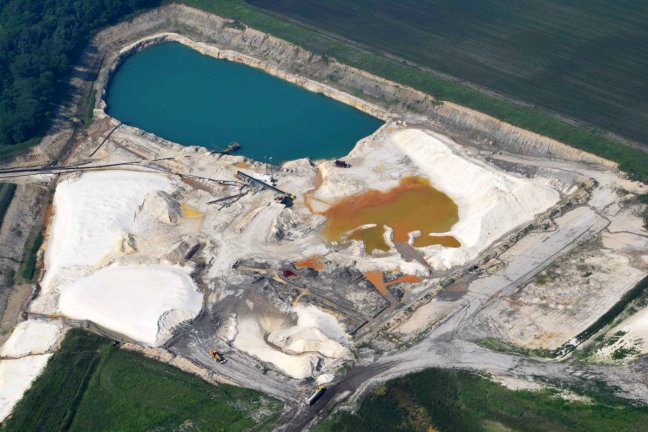
Frac sand mine in Utica, Illinois, located on Route 6 near Starved Rock State Park. Photo by: Lisa Held

In the Midwest, fertile soil is being excavated in pursuit of fossil fuels, while communities suffer.

By: Lisa Held, Civil Eats

One Monday in June, excavators were tearing into a field in Wedron, Illinois where the nubs of last season’s dried corn stalks were still sticking out of the ground. Behind where the crew worked, strips of earth had been carved out like steps on a wide staircase descending to the bottom of a deep pit. On the far side, fine sand the color of snow was piled in front of soaring, solid walls of sandstone. Picture standing on a ledge looking down into the biggest rock quarry you’ve ever seen. Then, enlarge that image 100 times, whitewash it, and add turquoise blue pools of wastewater. This is silica mining.

Fracking, a process used to extract natural gas and petroleum, depends on silica sand, or “frac sand” to produce the fossil fuels. A single fracking site can use millions of pounds of sand. The sand is blasted into wells to keep fissures in the rock open so that oil and gas can be released.

In the Midwest, farmland is being irreversibly lost in pursuit of silica sand.

Wedron Silica, which is now owned by Ohio-based Covia, has been expanding this particular mine for years and now owns at least 2,500 acres in and around the tiny village. It’s just one of several that Covia owns across LaSalle County, Illinois, 90 miles southwest of Chicago. Here, U.S. Silica, Smart Sand, and other companies are also actively mining.

Together, the companies have purchased hundreds of parcels of land and now own more than 9,000 acres in LaSalle, a Civil Eats investigation has found. The majority of those acres are former or current farmland. Silica mining is also prevalent in other parts of Illinois and regions of Wisconsin and Missouri.

Read full article: https://civileats.com/2022/07/19/from-farmland-to-frac-sand/

Frac Sand Mining near Starved Rock State Park, La Salle County, Illinois, YouTube videos